Insights on AI governance, public sector innovation, and democracy
Showing 15 of 47 results in category "AI Tools"
AI Tools
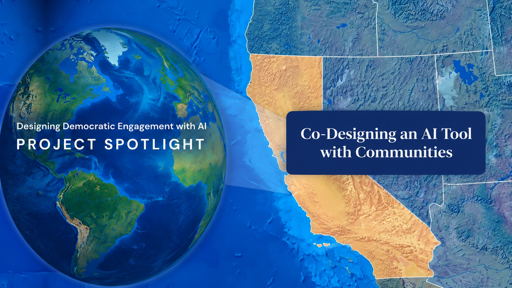
Project Spotlight: Co-Designing an AI Tool with Communities
California's AI-EP project made parents co-designers of an AI tool that makes their children's education plans easier to understand. More than 200 families joined the first pilot and came away better able to advocate for their kids. It shows that who you choose to include shapes who the tool serves.
Published on Sep 27, 2026 by Joanna French
AI Tools
What Is AI For? Four Questions Guiding Reboot This Fall
The public conversation about AI has swung from exuberance to alarm, casting AI as an unstoppable force. That framing overlooks the fact that public institutions design, build, buy, and regulate AI, and societies still choose where it leads. This fall, Reboot is organizing its coverage around four connected questions: what capabilities public institutions need, how they can become institutions that listen and learn, what public AI infrastructure requires, and how we measure whether AI is actually creating public value.
Published on Sep 14, 2026 by Beth Simone Noveck and Elana Banin
AI Tools
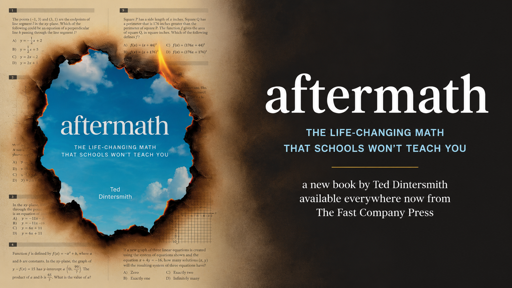
The real math crisis isn’t the test scores. It’s the test
Ted Dintersmith and Beth Simone Noveck argue that America’s high school math curriculum remains rooted in the needs of the 19th century rather than the AI era. They call for replacing an emphasis on rote procedures with quantitative reasoning, statistics, probability, and decision-making skills that people actually use. The authors propose using AI to engage thousands of students, educators, parents, and employers in redesigning math education through large-scale, democratic public participation.
Published on Jul 23, 2026 by Beth Simone Noveck and Ted Dintersmith
AI Tools
Information Literacy Is No Longer Just an Individual Skill
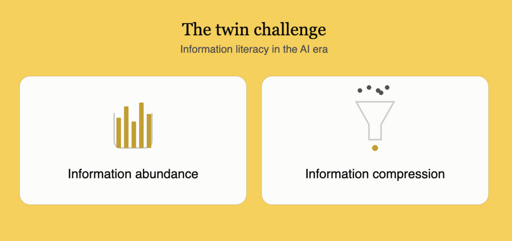
The debate about AI has focused on misinformation and AI slop, but those are only part of the story. As AI creates both unprecedented information abundance and information compression, we need a new conception of information literacy—one that encompasses how individuals reason, how communities learn together, and how democratic institutions use AI to become better listeners and problem-solvers.
Published on Jul 21, 2026 by Beth Simone Noveck
AI Tools
From AI Adoption to Public Value: InnovateUS Fall 2026 Live Learning Series
AI adoption in government is accelerating. The next challenge is making sure it creates public value. InnovateUS’s Fall 2026 Live Learning Series explores how public professionals can move beyond using AI to measuring its impact, governing it responsibly, and ensuring it improves outcomes for the people and communities government serves.
Published on Jun 30, 2026 by Agueda Quiroga
AI Tools
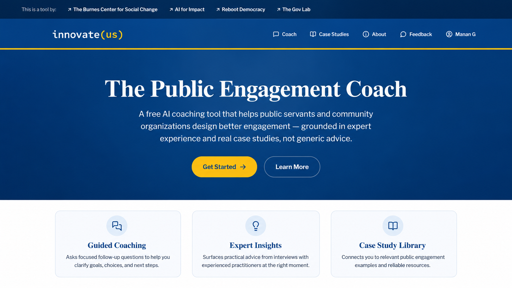
From Learning to Doing: An AI Coach for Public Engagement
A new AI for Impact-engineered public engagement coach is helping public servants turn what they learned about engagement into practical action. Built by The GovLab, the tool guides practitioners through real planning decisions, asks targeted questions about their specific project, and draws on engagement frameworks, case studies, and practitioner expertise to help them design more effective public participation processes.
Published on Jun 22, 2026 by Manan Gangwani, Kushal Pendekanti and Cevdet Batuhan Isik
AI Tools
The World Cup Is Here. So is VAR. Here's What That Mess Can Teach Us About A.I.
Billions of people are about to watch the World Cup. And millions of them will spend part of it furious, not at the teams, but at football's most contentious technology: the Video Assistant Referee. In this article, Anirudh Dinesh argues we are making the same mistake in how we design, build, and use AI, and shares four lessons VAR can teach us about what happens when you build tech without asking who it's actually meant for.
Published on Jun 10, 2026 by Anirudh Dinesh
AI Tools
Turning 20 Years of Community Board Data Into Searchable Public Knowledge
Local government generates enormous amounts of public knowledge, but much of it remains buried in disconnected PDFs and difficult-to-navigate archives. This post explores how the Block Party team used AI, semantic search, and human expertise to build a searchable archive of 17 years of Manhattan Community Board 3 resolutions, making local government decisions, institutional memory, and civic participation more accessible to residents, journalists, and public officials.
Published on Jun 9, 2026 by Sarah Sachs and Tal Roded
AI Tools
Bellagio: Five Days, 16 Members of Congress, and an Unusually Honest Conversation About AI
Mariana Becerra of the Eleanor Crook Foundation went to the Rockefeller Foundation’s Bellagio Center expecting a conversation about AI and geopolitical competition with bipartisan, bicameral members of Congress. She came back convinced that AI is already reshaping how public health systems function, how advocacy operates, and which organizations will have the capacity to influence policy. Drawing on conversations with lawmakers, researchers, and philanthropy leaders, this piece examines the growing gap between where AI governance debates are happening and the resulting consequences.
Published on May 27, 2026 by Mariana Becerra
AI Tools
The Future We Build: Hope and Public Service at Code for America Summit
A reflection from Rob Asaro-Angelo, Senior Fellow at the Burnes Center, from the 2026 Code for America Summit on why optimism in government depends on implementation. Drawing from conversations on procurement reform, service delivery, and AI in the public sector, the piece explores how public servants across the country are turning institutional frustration into practical change and why hope becomes credible when people have the tools, authority, and persistence to make systems work better.
Published on May 18, 2026 by Robert Asaro-Angelo
AI Tools
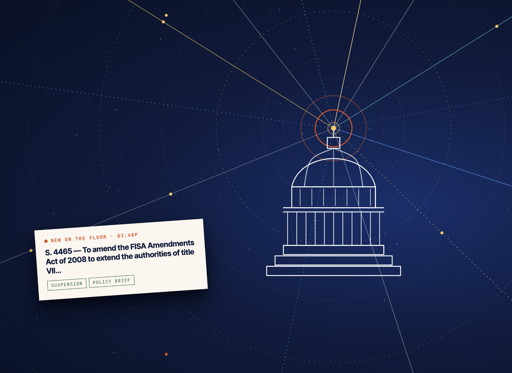
The Capitol Wire & Building Congressional Intelligence for Everyone
Congressional information has long been technically public but practically inaccessible, scattered across government sites and locked behind expensive subscription platforms. In response, Zach Florman, Communications Director for Rep. Laura Friedman, created the Capitol Wire tool. The Capitol Wire shows how AI can close that gap by turning floor schedules, bill texts, and legislative updates into real-time alerts and searchable policy briefs that are fast, verifiable, and free. The result is a tool that makes public information more legible for staffers, reporters, and citizens alike, and increases the likelihood of public engagement.
Published on May 11, 2026 by Zachary Florman
AI Tools
Before you engage, listen: a framework for citizen participation across the policy cycle
A mayor presents a plan, residents push back, and everyone leaves frustrated, not because people weren’t heard, but because listening and engagement happened at the wrong moment. This piece reframes participation as a cycle: listening to set the agenda, engagement to shape decisions, and follow-through to prove input mattered. The example of St. Louis shows how sequencing these stages turns public input into real outcomes, with AI enabling reflection on input at scale.
Published on Apr 27, 2026 by Wietse Van Ransbeeck
AI Tools
A Dozen Interns on Cocaine: What One of the Longest-Running Civic Tech Projects Reveals About AI in Government
What happens when governments rely on systems that sound right instead of being right? Drawing on OpenFisca’s spread from France to governments across Europe, Africa, and Oceania, Beth Simone Noveck’s interview with Matti Schneider makes the case for public infrastructure that computes the law, as well as the risks of sidelining it as generative AI scales globally.
Published on Apr 22, 2026 by Beth Simone Noveck
AI Tools
How we used AI to lift the voices of California state employees
Using AI to analyze over 2,400 employee comments, California’s Engaged California team found that the challenge wasn’t the scale of the data, but making sense of complex, layered input without oversimplifying it. Their experience shows why human judgment remains essential, from building taxonomies to catching errors, as results can shift significantly depending on how AI is applied and what people choose to trust and prioritize.
Published on Apr 21, 2026 by Summer Mothwood
AI Tools
What Good AI In Government Actually Looks Like
More than $1 trillion in federal grants flows to communities each year, but complexity keeps much of it out of reach. This piece by Beth Simone Noveck, published by Fast Company, explores how AI can either deepen that gap or help close it. The solution is GrantWell, a community-centered tool designed with local governments to make funding accessible and public systems work as intended. Launched in Massachusetts and expanding to additional states, it shows how AI can help communities claim the resources already set aside for them.
 InnovateUS