Insights on AI governance, public sector innovation, and democracy
Showing 15 of 16 results in category "AI and Education"
AI and Education
InnovateUS Awarded National Leadership Grant to Expand Civic AI Learning Alongside New Jersey, Montana, and Hawai'i State Libraries
Three-Year Multistate Initiative Will Combine Free Mobile AI Learning with Library-Based Programs Helping Residents Navigate Government, Participate in Civic Life, and Solve Community Problems with AI
Published on Sep 21, 2026 by Bonnie McGilpin
AI and Education
What Is AI For? Four Questions Guiding Reboot This Fall
The public conversation about AI has swung from exuberance to alarm, casting AI as an unstoppable force. That framing overlooks the fact that public institutions design, build, buy, and regulate AI, and societies still choose where it leads. This fall, Reboot is organizing its coverage around four connected questions: what capabilities public institutions need, how they can become institutions that listen and learn, what public AI infrastructure requires, and how we measure whether AI is actually creating public value.
Published on Sep 14, 2026 by Beth Simone Noveck and Elana Banin
AI and Education
The real math crisis isn’t the test scores. It’s the test
Ted Dintersmith and Beth Simone Noveck argue that America’s high school math curriculum remains rooted in the needs of the 19th century rather than the AI era. They call for replacing an emphasis on rote procedures with quantitative reasoning, statistics, probability, and decision-making skills that people actually use. The authors propose using AI to engage thousands of students, educators, parents, and employers in redesigning math education through large-scale, democratic public participation.
Published on Jul 23, 2026 by Beth Simone Noveck and Ted Dintersmith
AI and Education
Information Literacy Is No Longer Just an Individual Skill
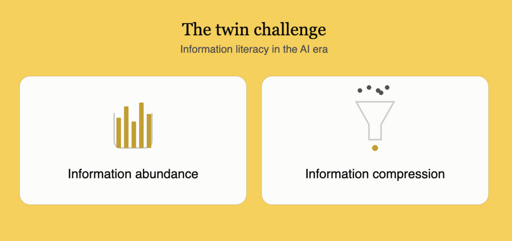
The debate about AI has focused on misinformation and AI slop, but those are only part of the story. As AI creates both unprecedented information abundance and information compression, we need a new conception of information literacy—one that encompasses how individuals reason, how communities learn together, and how democratic institutions use AI to become better listeners and problem-solvers.
Published on Jul 21, 2026 by Beth Simone Noveck
AI and Education
The Herald: Pretending AI is not in schools could pose the biggest risk
Beth Simone Noveck spoke to The Herald (Scotland) about the role of AI in education and the need for decision-makers to engage with the technology rather than fear it, ahead of her talk at the Edinburgh Futures Institute's Civic University – Democracy, AI, and the Public Imagination."
Published on Jun 15, 2026
AI and Education
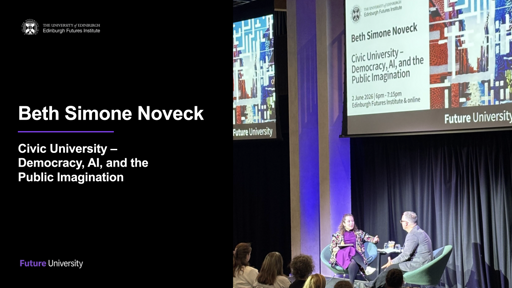
Civic University – Democracy, AI, and the Public Imagination
As AI transforms how we work, learn, and govern, what role should universities play? In this wide-ranging conversation, Beth Noveck argues that universities should become laboratories for democratic problem-solving, where students work with communities to address public challenges. She outlines a vision for "democratic AI" that puts public purpose, participation, and impact at the center of technological innovation.
Published on Jun 8, 2026 by Beth Simone Noveck
AI and Education
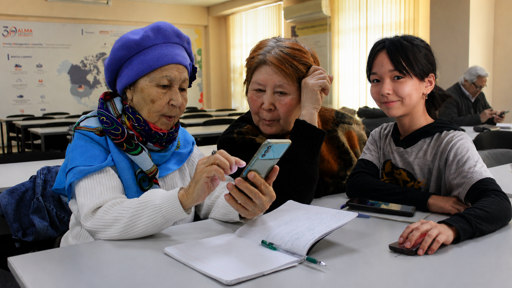
From digital to AI-enabled government: Kazakhstan's next frontier
Kazakhstan built one of the world’s most advanced digital governments in less than two decades. Now the country is racing into the next phase: AI-enabled governance, sovereign AI infrastructure, and nationwide AI deployment. But this transition is exposing a harder question beneath the ambition: what happens when countries move toward frontier AI systems before large parts of the population have reliable electricity, affordable internet, laptops, or the skills needed to use AI meaningfully?
Published on Jun 3, 2026 by Gulnaz Kordanova
AI and Education
The Scotsman: Scotland uniquely able to redefine the purpose of universities, Obama advisor claims
Ahead of a timely conversation around the civic role of the university in an age of democratic uncertainty and rapid technological change, Beth Simone Noveck spoke to the Scotsman about how Scotland's universities are uniquely place to reinvent the purpose of higher education.
Published on Jun 2, 2026 by Beth Simone Noveck
AI and Education
Mandatory Reporting vs. Substantive Oversight: Examining AI Ethics in the Turkish School System
As governments search for ways to operationalize AI ethics inside public institutions, Türkiye’s new YAZEK system offers an early example of what procedural AI governance can look like in practice. The piece examines how the Ministry of Education embedded mandatory AI ethics declarations into everyday administrative workflows, while also exploring the system’s limits around verification, oversight, and remedy when automated systems cause harm.
Published on May 20, 2026 by Elif Davutoglu
AI and Education
Who Gets to Define the AI Debate? A Youth Perspective
A high school journalist reflects on who is shaping the public conversation about AI. While headlines focus on risk and disruption, everyday uses of AI are already helping families access benefits, students learn, and cities deliver services. The gap, Amedeo Bettauer argues, is in between those whose experiences count in defining the debate and those in power who seek out diverse experiences.
Published on May 4, 2026 by Amedeo Bettauer
AI and Education
The Case for Civic AI Compacts with Higher Education
Cities often treat nearby universities as occasional partners rather than strategic collaborators. But as artificial intelligence reshapes local economies and public services, that relationship may need to change. Drawing on a new policy brief, The AI Lab Next Door, Neil Kleiman argues that city–university “compacts” can transform transactional ties into intentional partnerships, helping communities harness the growing AI capacity already taking shape on college campuses.
Published on Mar 17, 2026 by Neil Kleiman
AI and Education
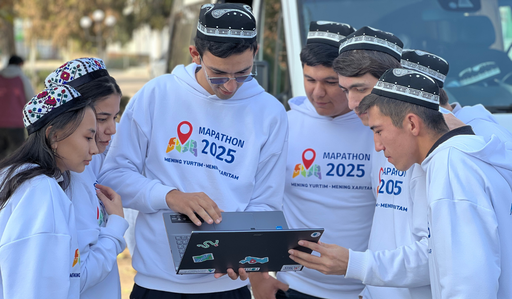
Global AI Watch: Mapping the School, Seeing the System: How Spatial Context Reshaped Public Decision-Making in Uzbekistan and Bhutan
Crowdsourced mapping of schools in Uzbekistan and Bhutan combined with AI data analysis created greater insight into on-the-ground conditions. By treating geography as essential, spatial data, participatory collection, and AI analysis reshaped how evidence-informed public investment and policy decisions are made in Uzbekistan and Bhutan.
Published on Jan 28, 2026 by Aziza Umarova
AI and Education
Learning Together to Improve Public Service
Since its creation in 2023, InnovateUS’s training offerings have supported public professionals in making sense of change together, building capacity, and strengthening their ability to make informed decisions in practice. Our Spring 2026 workshop offering, which we’re presenting today, reflects insights from learners, partners, and experts about the challenges facing public service today.
Published on Dec 15, 2025 by Agueda Quiroga
AI and Education
When Communities Lead, Appropriate Tech and Change Follow
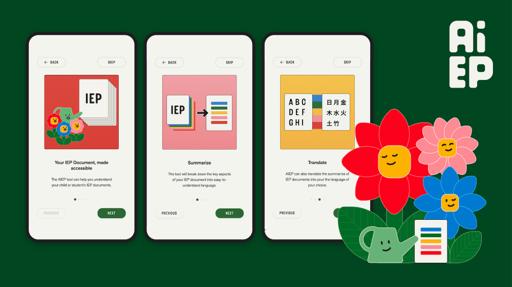
Co-designed with parents, the AIEP tool is both a technical solution and a catalyst for civic power for families of children with diverse abilities. By building AI literacy through in-person training and WhatsApp-based courses, the project offers a model for community-centered technology, making education systems more navigable and equitable.
AI tools can open doors to access and advocacy, but it’s human connection and support networks that give those tools meaning. That is where the most powerful change is taking shape, and where investment matters most.
Published on Sep 30, 2025 by Sofía Bosch Gómez
AI and Education
friend.com or foe.com?
The New York City subway would never accept an ad for a hitman-for-hire service, or for a pill that claimed to cure depression but wasn’t FDA-approved, or a social network designed exclusively to groom minors. Those would be illegal, unethical—and obviously dangerous. So why is the MTA running a massive ad campaign for friend.com, a product that, if not already illegal, certainly should be?
Published on Sep 28, 2025 by Beth Simone Noveck and Amedeo Bettauer
 InnovateUS