Insights on AI governance, public sector innovation, and democracy
Showing 15 of 51 results in category "AI and Lawmaking"
AI and Lawmaking
What Is AI For? Four Questions Guiding Reboot This Fall
The public conversation about AI has swung from exuberance to alarm, casting AI as an unstoppable force. That framing overlooks the fact that public institutions design, build, buy, and regulate AI, and societies still choose where it leads. This fall, Reboot is organizing its coverage around four connected questions: what capabilities public institutions need, how they can become institutions that listen and learn, what public AI infrastructure requires, and how we measure whether AI is actually creating public value.
Published on Sep 14, 2026 by Beth Simone Noveck and Elana Banin
AI and Lawmaking
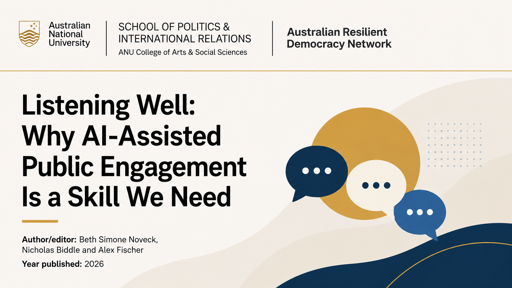
Learning to Listen: Why AI-Assisted Public Engagement Is a Skill We Need
Two trends are unfolding in parallel around the world. Public anxiety about artificial intelligence is growing while communities’ satisfaction in how they participate in civic activities and contribute to government policy and programs is declining. Pathways to resolve this tension are emerging as governments find ways to use these technologies to help communities participate more meaningfully. Examples from Bogotá, Hamburg, Brazil, Mexico and elsewhere show how AI can improve the quality and experience of public engagement while reducing its time and cost. If done poorly, or without safeguards, it can also introduce new risks. However, these can be managed with appropriate process design, regulation and delivery by skilled practitioners.
Published on Aug 10, 2026 by Beth Simone Noveck, Nicholas Biddle and Alex Fischer
AI and Lawmaking
Bummed About AI? Democratic Societies Need Public Participation to Shape It
AI presents real risks, but disengagement leaves its future to others. Drawing on principles of negotiation, mediation, and decision-making, this essay by John Lande, Isidor Loeb Professor Emeritus at the University of Missouri School of Law, argues that democratic societies should approach AI as they would any difficult dispute: by carefully weighing risks and opportunities, exercising sound judgment under conditions of uncertainty, and participating in the decisions that will shape its future. This blog is adapted from a University of Missouri School of Law Legal Studies SSRN paper.
Published on Jul 28, 2026 by John Lande
AI and Lawmaking
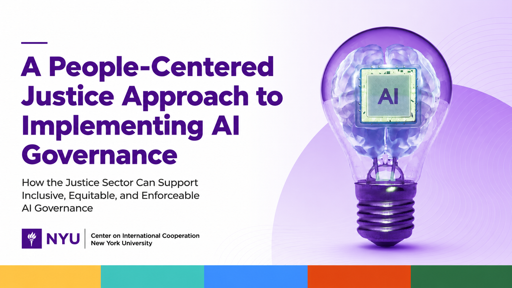
Why Effective AI Governance Depends on Strong Justice Systems
As governments rush to regulate AI, many governance frameworks still overlook what happens when people are harmed. This piece argues that AI governance will be tested by legal systems already struggling to deliver equal access to justice. Drawing on the recent report "A People-Centered Justice Approach to Implementing AI Governance," examples from Australia, the Netherlands, and the United States make the case for bringing courts, legal aid organizations, and justice institutions into the center of AI governance design.
Published on May 25, 2026 by Nate Edwards
AI and Lawmaking
The Reports Nobody Reads: How San Francisco Used AI to Declutter Its Municipal Code
In a new piece for the Rethinking Regulation series, Dane Gambrell examines how San Francisco used a custom AI tool developed with Stanford’s RegLab to scan 16 million words of municipal code and identify hundreds of outdated and duplicative reporting requirements across city government. The effort ultimately produced a 351-page ordinance proposing the deletion or consolidation of 174 mandates. The piece offers a grounded look at how AI can help governments make sprawling bureaucratic systems more legible and manageable.
Published on May 19, 2026 by Dane Gambrell
AI and Lawmaking
AI Doesn’t Understand Kichwa: Ecuador’s Case for Inclusive AI Governance in the Justice System
In a new piece for Reboot Democracy, Rodrigo Cetina-Presuel, Marco Tello, and Jose M. Martinez-Sierra examine how Ecuador’s judiciary responded to the rapid arrival of AI by building a participatory governance process rooted in the country’s institutional and cultural realities. Through consultations with judicial officials, the process surfaced a critical gap ignored by most international AI frameworks: current AI systems cannot reliably interpret Indigenous languages or legal contexts such as Kichwa. The result was one of the region’s first judicial AI moratoriums, temporarily prohibiting the use of AI in Indigenous-language cases while Ecuador develops more legitimate and locally grounded governance mechanisms for the future.
Published on May 12, 2026 by Rodrigo Cetina-Presuel, Jose M. Martinez-Sierra and Marco Tello
AI and Lawmaking
The Capitol Wire & Building Congressional Intelligence for Everyone
Congressional information has long been technically public but practically inaccessible, scattered across government sites and locked behind expensive subscription platforms. In response, Zach Florman, Communications Director for Rep. Laura Friedman, created the Capitol Wire tool. The Capitol Wire shows how AI can close that gap by turning floor schedules, bill texts, and legislative updates into real-time alerts and searchable policy briefs that are fast, verifiable, and free. The result is a tool that makes public information more legible for staffers, reporters, and citizens alike, and increases the likelihood of public engagement.
Published on May 11, 2026 by Zachary Florman
AI and Lawmaking
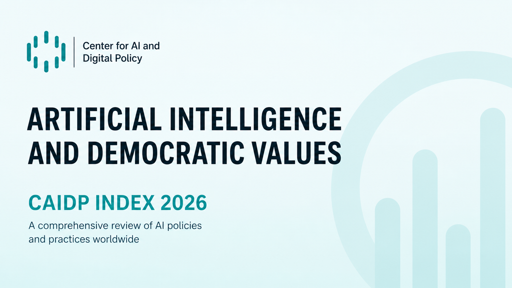
Progress on Global AI Governance: The CAIDP AI Index and Implications for the Public Sector
The 2026 CAIDP AI Index, ranking AI policy commitments across 90 countries, shows that while most governments now agree on core governance principles, the real divide lies in implementation. Many are advancing laws, oversight, and public participation, but progress lags in turning commitments into practice. As the baseline shifts from whether to govern AI to how, the report underscores that outcomes depend less on frameworks and more on the capacity of public institutions—and the civil servants within them—to operationalize these principles in everyday decisions.
Published on May 6, 2026 by April Yoder and Grace Thomson
AI and Lawmaking
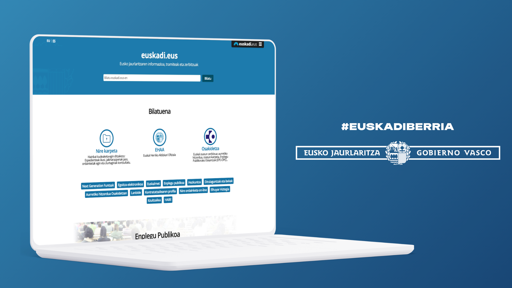
Governing with Others: The Basque Country Turns Collaboration into Rule of Law
As the Basque Government moves to pass a new Transparency Law this May, it is redefining what transparency means. No longer just about access to information, the law embeds collaborative governance into its core, requiring that decision-making processes be open, traceable, and shaped with others. This piece explores what it looks like to turn participation from a principle into a legal obligation, and what it takes to make participation a structured, accountable part of how policy is made.
Published on Apr 29, 2026 by Xabier Barandiaran
AI and Lawmaking
A Dozen Interns on Cocaine: What One of the Longest-Running Civic Tech Projects Reveals About AI in Government
What happens when governments rely on systems that sound right instead of being right? Drawing on OpenFisca’s spread from France to governments across Europe, Africa, and Oceania, Beth Simone Noveck’s interview with Matti Schneider makes the case for public infrastructure that computes the law, as well as the risks of sidelining it as generative AI scales globally.
Published on Apr 22, 2026 by Beth Simone Noveck
AI and Lawmaking
What AI Governance Documents Actually Cover and What They Don’t
AI governance is expanding fast, but not evenly. A new analysis from MIT and Georgetown’s CSET maps over 1,000 governance documents to show that while policies are proliferating, they cluster around familiar risks and sectors, leaving key gaps across socioeconomic impacts, upstream design, and everyday domains. The result, as relayed by research member Yan Zhu, is a more precise picture of what AI governance actually covers, what it still overlooks, and where policymakers should focus in the future.
Published on Apr 20, 2026 by Yan Zhu
AI and Lawmaking
Can AI Strengthen Policy Dialogue? Lessons from Building ReguLens
Developed by the International Training Centre of the International Labour Organization with and for employer organizations, ReguLens responds to a growing policy bottleneck. The rapid surge in complex, overlapping regulations is outpacing institutional capacity. Built through iterative co-creation with users across regions, the tool helps organizations analyze proposals, identify impacts, and engage earlier in policy debates.
Published on Apr 8, 2026 by Jorge Cesar Ramirez Mata
AI and Lawmaking
Assembly Required: A Conversation with Lorelei Kelly on Deliberative Technology and Congressional Reform
In this conversation with Elana Banin, Lorelei Kelly argues that rebuilding democratic resilience requires redesigning the institutional infrastructure connecting citizens to Congress. Drawing on constitutional history and emerging technologies, she explores how deliberative technology and AI could help revive the First Amendment’s promises of assembly and petition for the digital age.
Published on Mar 10, 2026 by Elana Banin
AI and Lawmaking
Using AI to Support Public Deliberation: A Conversation with Audrey Tang
In this InnovateUS workshop, Audrey Tang and Danielle Allen discuss how AI-enabled civic technologies, paired with radical transparency and thoughtful institutional design, can help democracies respond to problems faster, govern more fairly, and rebuild public trust. Lessons from Taiwan, California, and other contexts show how combining digital tools with in-person engagement can surface common ground and reduce polarization. Together, the speakers argue that democracy can meet today’s challenges when it is designed to be fast, fair, and genuinely engaging for the people it serves.
Published on Dec 19, 2025 by Dane Gambrell and Beth Simone Noveck
AI and Lawmaking
The Future of Constituent Engagement with Congress
In testimony before the House Subcommittee on Modernization and Innovation, Dr. Beth Simone Noveck argues that Congress’s challenge is too little institutional capacity to use public input. With committee staff and in-house expertise sharply reduced and more than 81 million constituent communications each year, traditional engagement has become costly, slow, and often performative. Drawing on examples from the U.S., Brazil, Germany, among others, she shows how pairing disciplined engagement design with AI tools can help Congress synthesize public input, surface expertise, and strengthen lawmaking at scale.
 InnovateUS