Insights on AI governance, public sector innovation, and democracy
Showing 12 of 12 results in category "AI and Public Safety"
AI and Public Safety
Project Spotlight: Engaged California — Wildfire Recovery Action Planning
After the 2025 Los Angeles wildfires, California's Office of Data and Innovation used Engaged California to gather more than 1,300 resident comments. AI helped turn that input into 19 policy options, which residents then deliberated over and ranked. Jeffery Marino explains how clear ownership, with state agencies, local governments, and community groups acting together with support from the Governor's office, turned those priorities into a five-part recovery action plan.
Published on Oct 5, 2026 by Jeffery Marino
AI and Public Safety
What Is AI For? Four Questions Guiding Reboot This Fall
The public conversation about AI has swung from exuberance to alarm, casting AI as an unstoppable force. That framing overlooks the fact that public institutions design, build, buy, and regulate AI, and societies still choose where it leads. This fall, Reboot is organizing its coverage around four connected questions: what capabilities public institutions need, how they can become institutions that listen and learn, what public AI infrastructure requires, and how we measure whether AI is actually creating public value.
Published on Sep 14, 2026 by Beth Simone Noveck and Elana Banin
AI and Public Safety
From AI Adoption to Public Value: InnovateUS Fall 2026 Live Learning Series
AI adoption in government is accelerating. The next challenge is making sure it creates public value. InnovateUS’s Fall 2026 Live Learning Series explores how public professionals can move beyond using AI to measuring its impact, governing it responsibly, and ensuring it improves outcomes for the people and communities government serves.
Published on Jun 30, 2026 by Agueda Quiroga
AI and Public Safety
Why Effective AI Governance Depends on Strong Justice Systems
As governments rush to regulate AI, many governance frameworks still overlook what happens when people are harmed. This piece argues that AI governance will be tested by legal systems already struggling to deliver equal access to justice. Drawing on the recent report "A People-Centered Justice Approach to Implementing AI Governance," examples from Australia, the Netherlands, and the United States make the case for bringing courts, legal aid organizations, and justice institutions into the center of AI governance design.
Published on May 25, 2026 by Nate Edwards
AI and Public Safety
But Grok Said So! How AI is Enabling Political Polarization
Across contexts like India, where author Anirudh Dinesh’s family lives, AI chatbots such as xAI’s Grok are increasingly used not to inform but to generate arguments that reinforce existing political views, creating “generative echo chambers.” Unlike passive social media exposure, users actively prompt AI to validate positions, often producing confident but inaccurate claims that go unchecked. While some research suggests AI can moderate views in neutral dialogue, real-world use skews toward advocacy, compounded by low verification and high trust in outputs. The result is that AI may not just reflect polarization, but actively deepen it, depending on how these systems are designed and used.
Published on Apr 15, 2026 by Anirudh Dinesh
AI and Public Safety
Prediction Isn’t Intelligence: How Predictive Models Really Work in Government
A hiring tool changes your "personality" score based on whether there's a bookshelf behind you in an interview. A hospital model suggests asthmatics are safer—because it learned how to respond to the triage system, not the disease. This InnovateUS workshop explains why predictive AI needs governance, not just accuracy.
Published on Jan 27, 2026 by Stephan Schmidt
AI and Public Safety
Global Watch: Hillerød, Denmark is crowdsourcing its way through a traffic jam
Facing worsening congestion and no room to build new roads, Hillerød, Denmark, turned to its residents for direction. Diverse engagement channels and AI tools helped the city identify priorities politicians hadn’t anticipated.
Published on Jan 14, 2026 by Nico Campbell
AI and Public Safety
Learning Together to Improve Public Service
Since its creation in 2023, InnovateUS’s training offerings have supported public professionals in making sense of change together, building capacity, and strengthening their ability to make informed decisions in practice. Our Spring 2026 workshop offering, which we’re presenting today, reflects insights from learners, partners, and experts about the challenges facing public service today.
Published on Dec 15, 2025 by Agueda Quiroga
AI and Public Safety
Why “Good Guys” Shouldn’t Use AI like the “Bad Guys”: The Failure of Predictive Policing
This essay argues that predictive policing continues to fail not because police departments lack data, but because they are using the wrong kind of data, in the wrong way. Applying low-stakes commercial algorithms to high-stakes decisions can produce dangerous false positives, reinforce biased patterns, and erode public trust in policing. Using examples from Plainfield, NJ, and Chicago, the piece illustrates how predictive systems replicate past police behavior rather than accurately forecasting crime, thereby creating self-reinforcing feedback loops. It contrasts these failures with diagnostic approaches in Oakland and Richmond that utilize data to understand harm, guide outreach, and reduce violence without relying on algorithmic surveillance. The core argument is that policing needs better mirrors, not crystal balls.
Published on Nov 17, 2025 by Mihir Kshirsagar
AI and Public Safety
Governing the Undefined: Why the Debate Over Superintelligence Misses the Point
As headlines warn of “superintelligent AI” threatening human extinction, a new open letter reignites familiar fears. But beneath the apocalyptic rhetoric lies a deeper problem. The narrative around artificial superintelligence, long embraced by Big Tech, diverts attention from the real and immediate challenges of AI and how our democratic institutions can address them.
Published on Oct 29, 2025 by Dane Gambrell
AI and Public Safety
How Hamburg is Turning Resident Comments into Actionable Insight
Officials in Hamburg had long struggled with the fact that while citizens submitted thousands of comments on planning projects, only a fraction could realistically be read and processed. Making sense of feedback from a single engagement could once occupy five full-time employees for more than a week and chill any desire to do a follow-up conversation. Learn about how Hamburg built its own open source artificial intelligence to make sense of citizen feedback on a scale and speed that was once unimaginable.
Published on Oct 22, 2025 by Beth Simone Noveck
AI and Public Safety
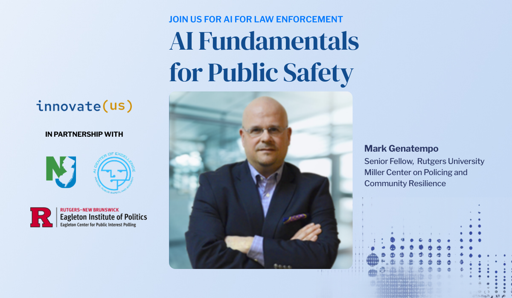
AI is a Power Tool, Not a Decision Maker: Essential Lessons for Law Enforcement
Law enforcement agencies are under pressure to explore AI, but the real lesson is to treat it like any other power tool. In a recent workshop, Rutgers Senior Fellow Mark Genatempo stressed that AI should support, not replace, human decision-making. From distinguishing between machine learning, predictive analytics, and generative AI, to auditing data and building community trust, the key is preparation, oversight, and transparency. With the right training and safeguards, AI can enhance public safety without undermining accountability.
 InnovateUS