Insights on AI governance, public sector innovation, and democracy
Showing 15 of 85 results in category "AI for Governance"
AI for Governance
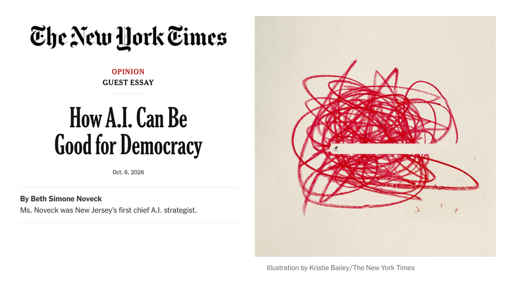
How A.I. Can Be Good for Democracy
In a New York Times guest essay, Beth Simone Noveck makes the case for putting A.I. behind every public servant. She draws on examples from New Jersey, California, the U.K., South Korea and South Australia, and calls for three investments: training the public workforce, giving workers secure access to multiple models, and using government purchasing power to build open, accountable A.I.
Published on Oct 6, 2026 by Beth Simone Noveck
AI for Governance
Project Spotlight: Engaged California — Wildfire Recovery Action Planning
After the 2025 Los Angeles wildfires, California's Office of Data and Innovation used Engaged California to gather more than 1,300 resident comments. AI helped turn that input into 19 policy options, which residents then deliberated over and ranked. Jeffery Marino explains how clear ownership, with state agencies, local governments, and community groups acting together with support from the Governor's office, turned those priorities into a five-part recovery action plan.
Published on Oct 5, 2026 by Jeffery Marino
AI for Governance
InnovateUS Awarded National Leadership Grant to Expand Civic AI Learning Alongside New Jersey, Montana, and Hawai'i State Libraries
Three-Year Multistate Initiative Will Combine Free Mobile AI Learning with Library-Based Programs Helping Residents Navigate Government, Participate in Civic Life, and Solve Community Problems with AI
Published on Sep 21, 2026 by Bonnie McGilpin
AI for Governance
Designing Democratic Engagement with AI: A New Course for Turning Public Input into Public Policy
A new free course from the Allen Lab for Democracy Renovation, The GovLab, and InnovateUS teaches public servants how to design AI-enabled public engagement that turns comments into policy, drawing on 42 real-world examples from 20 countries.
Published on Sep 15, 2026 by Dane Gambrell and Sarah Hubbard
AI for Governance
What Is AI For? Four Questions Guiding Reboot This Fall
The public conversation about AI has swung from exuberance to alarm, casting AI as an unstoppable force. That framing overlooks the fact that public institutions design, build, buy, and regulate AI, and societies still choose where it leads. This fall, Reboot is organizing its coverage around four connected questions: what capabilities public institutions need, how they can become institutions that listen and learn, what public AI infrastructure requires, and how we measure whether AI is actually creating public value.
Published on Sep 14, 2026 by Beth Simone Noveck and Elana Banin
AI for Governance
Democracy's Compression Problem
AI is making it possible for governments to listen at a scale that was previously impossible, turning thousands of comments, service interactions and other signals into usable knowledge. But automated synthesis is not neutral: every act of compression determines what becomes visible, what disappears and ultimately what institutions come to know. If AI is to strengthen democracy rather than flatten it, AI-assisted listening must meet a higher standard: fidelity to what people actually said, preservation of plurality and disagreement, traceability back to the underlying evidence, contestability by those being represented, and a clear connection between what is heard and consequential decisions.
Published on Aug 25, 2026 by Beth Simone Noveck
AI for Governance
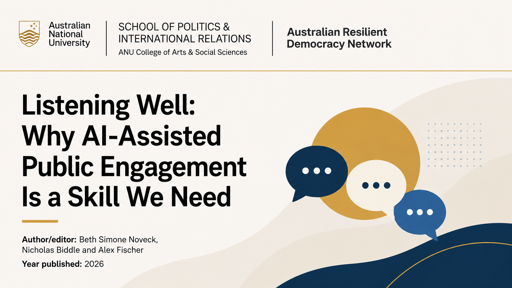
Learning to Listen: Why AI-Assisted Public Engagement Is a Skill We Need
Two trends are unfolding in parallel around the world. Public anxiety about artificial intelligence is growing while communities’ satisfaction in how they participate in civic activities and contribute to government policy and programs is declining. Pathways to resolve this tension are emerging as governments find ways to use these technologies to help communities participate more meaningfully. Examples from Bogotá, Hamburg, Brazil, Mexico and elsewhere show how AI can improve the quality and experience of public engagement while reducing its time and cost. If done poorly, or without safeguards, it can also introduce new risks. However, these can be managed with appropriate process design, regulation and delivery by skilled practitioners.
Published on Aug 10, 2026 by Beth Simone Noveck, Nicholas Biddle and Alex Fischer
AI for Governance
Mississippi's AI Framework Was the Starting Line
Mississippi has released its statewide AI framework. The harder challenge is turning guidance into practice. Drawing on firsthand experience leading the state’s AI workforce efforts, Dr. Kollin Napier of MAIN examines why successful AI adoption depends on sustained investment in training, governance, staffing, and implementation.
Published on Jul 6, 2026 by Dr. Kollin Napier
AI for Governance
From AI Adoption to Public Value: InnovateUS Fall 2026 Live Learning Series
AI adoption in government is accelerating. The next challenge is making sure it creates public value. InnovateUS’s Fall 2026 Live Learning Series explores how public professionals can move beyond using AI to measuring its impact, governing it responsibly, and ensuring it improves outcomes for the people and communities government serves.
Published on Jun 30, 2026 by Agueda Quiroga
AI for Governance
Democracy has a listening problem. These AI tools could actually help
This excerpt from Reboot: AI and the Race to Save Democracy was originally published in Fast Company on June 25, 2026.
Published on Jun 25, 2026 by Beth Simone Noveck
AI for Governance
An Open Society Needs an Open Market: The Compute Problem Cities, Regions, and Nations Share
A new report from the Canadian Anti-Monopoly Project argues that cloud sovereignty is about more than building domestic alternatives. It is about ensuring governments, businesses, and public institutions have autonomy and agency. Using Canada’s highly concentrated cloud market as a case study, the authors explore how procurement policy, competition rules, and interoperability standards could reduce dependence on hyperscalers and create a more competitive marketplace for compute.
Published on Jun 24, 2026 by David Eaves and Curtis McCord
AI for Governance
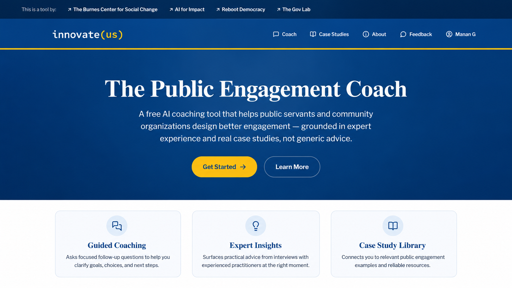
From Learning to Doing: An AI Coach for Public Engagement
A new AI for Impact-engineered public engagement coach is helping public servants turn what they learned about engagement into practical action. Built by The GovLab, the tool guides practitioners through real planning decisions, asks targeted questions about their specific project, and draws on engagement frameworks, case studies, and practitioner expertise to help them design more effective public participation processes.
Published on Jun 22, 2026 by Manan Gangwani, Kushal Pendekanti and Cevdet Batuhan Isik
AI for Governance
Training Future Leaders to Shape AI in the Public-Interest: Insights from the Barcelona Public-Interest AI Accelerator
A new accelerator in Barcelona is exploring what it takes to prepare future leaders to navigate the emerging field of public-interest AI. The experience underscored that moving from principles to practice demands leaders who understand the technical, political, economic, and ethical dimensions of AI. Leaders who are equipped to ensure these technologies serve public goals, protect rights, and respond to the needs of diverse communities.
Published on Jun 17, 2026 by Patricia Mangeol, Sunnie Gong, Rodrigo Cetina-Presuel and Júlia Devin Altès
AI for Governance
The Future of AI Runs Through Families: A conversation with Anya Kamenetz
What happens when the people working closest to families are forced to confront AI? In this conversation with Elana Banin, journalist Anya Kamenetz reflects on a three-day workshop that brought together service providers, advocates, technologists, policymakers, journalists, and philanthropists to wrestle with that question. The discussion explores why families have been largely absent from AI governance debates, how to shape the trajectory of technological change, and what it would take to build AI with communities rather than for them.
Published on Jun 15, 2026 by Elana Banin
AI for Governance
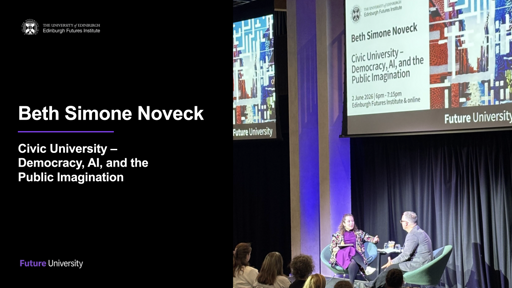
Civic University – Democracy, AI, and the Public Imagination
As AI transforms how we work, learn, and govern, what role should universities play? In this wide-ranging conversation, Beth Noveck argues that universities should become laboratories for democratic problem-solving, where students work with communities to address public challenges. She outlines a vision for "democratic AI" that puts public purpose, participation, and impact at the center of technological innovation.
 InnovateUS