Insights on AI governance, public sector innovation, and democracy
Showing 15 of 46 results in category "Governing AI"
Governing AI
How A.I. Can Be Good for Democracy
In a New York Times guest essay, Beth Simone Noveck makes the case for putting A.I. behind every public servant. She draws on examples from New Jersey, California, the U.K., South Korea and South Australia, and calls for three investments: training the public workforce, giving workers secure access to multiple models, and using government purchasing power to build open, accountable A.I.
Published on Oct 6, 2026 by Beth Simone Noveck
Governing AI
The Halitosis of Our Times
The Hugging Face incident wasn't a rogue AI escaping its sandbox. It was a chain of poor human decisions. We need to stop talking about AI like mythology and start treating it like engineering.
Published on Sep 30, 2026 by Anirudh Dinesh
Governing AI
The $170 billion lesson data center developers keep learning the hard way
Governors from Healey to Shapiro now say data centers need local buy-in, but they haven't said what a community "yes" actually looks like. Since 2024, at least 46 projects representing more than $170 billion have been blocked, withdrawn, or stalled, often because engagement started after the key decisions were made and benefits were whatever developers chose to offer. Deals in West Virginia, Louisiana, Texas, and Lancaster, Pennsylvania show the terms can be negotiated, but only if states give communities the capacity to take part: early information, independent expertise, and a process that developers can pay for without owning.
Published on Sep 28, 2026 by Dr. Deborah Stine and Beth Simone Noveck
Governing AI
What Is AI For? Four Questions Guiding Reboot This Fall
The public conversation about AI has swung from exuberance to alarm, casting AI as an unstoppable force. That framing overlooks the fact that public institutions design, build, buy, and regulate AI, and societies still choose where it leads. This fall, Reboot is organizing its coverage around four connected questions: what capabilities public institutions need, how they can become institutions that listen and learn, what public AI infrastructure requires, and how we measure whether AI is actually creating public value.
Published on Sep 14, 2026 by Beth Simone Noveck and Elana Banin
Governing AI
Democracy's Compression Problem
AI is making it possible for governments to listen at a scale that was previously impossible, turning thousands of comments, service interactions and other signals into usable knowledge. But automated synthesis is not neutral: every act of compression determines what becomes visible, what disappears and ultimately what institutions come to know. If AI is to strengthen democracy rather than flatten it, AI-assisted listening must meet a higher standard: fidelity to what people actually said, preservation of plurality and disagreement, traceability back to the underlying evidence, contestability by those being represented, and a clear connection between what is heard and consequential decisions.
Published on Aug 25, 2026 by Beth Simone Noveck
Governing AI
Learning to Listen: Why AI-Assisted Public Engagement Is a Skill We Need
Two trends are unfolding in parallel around the world. Public anxiety about artificial intelligence is growing while communities’ satisfaction in how they participate in civic activities and contribute to government policy and programs is declining. Pathways to resolve this tension are emerging as governments find ways to use these technologies to help communities participate more meaningfully. Examples from Bogotá, Hamburg, Brazil, Mexico and elsewhere show how AI can improve the quality and experience of public engagement while reducing its time and cost. If done poorly, or without safeguards, it can also introduce new risks. However, these can be managed with appropriate process design, regulation and delivery by skilled practitioners.
Published on Aug 10, 2026 by Beth Simone Noveck, Nicholas Biddle and Alex Fischer
Governing AI
AI Is Infrastructure. Govern It Accordingly.
As prediction increasingly shapes decisions about jobs, healthcare, education, and public services, the next frontier is how it organizes society. Drawing on the history of the railroads, this essay argues that policymakers already have a blueprint for governing essential technologies: treat AI as infrastructure, apply public oversight, and ensure that systems central to modern life serve the public interest rather than private power.
Published on Aug 3, 2026 by Mona Sloane
Governing AI
Mississippi's AI Framework Was the Starting Line
Mississippi has released its statewide AI framework. The harder challenge is turning guidance into practice. Drawing on firsthand experience leading the state’s AI workforce efforts, Dr. Kollin Napier of MAIN examines why successful AI adoption depends on sustained investment in training, governance, staffing, and implementation.
Published on Jul 6, 2026 by Dr. Kollin Napier
Governing AI
From AI Adoption to Public Value: InnovateUS Fall 2026 Live Learning Series
AI adoption in government is accelerating. The next challenge is making sure it creates public value. InnovateUS’s Fall 2026 Live Learning Series explores how public professionals can move beyond using AI to measuring its impact, governing it responsibly, and ensuring it improves outcomes for the people and communities government serves.
Published on Jun 30, 2026 by Agueda Quiroga
Governing AI
Democracy has a listening problem. These AI tools could actually help
This excerpt from Reboot: AI and the Race to Save Democracy was originally published in Fast Company on June 25, 2026.
Published on Jun 25, 2026 by Beth Simone Noveck
Governing AI
Research Radar: 10 Things Public Officials Should Know About AI Data Centers
AI data centers are arriving in communities long before most public institutions have figured out how to govern them. Drawing on recent analysis, fieldwork, and an InnovateUS workshop, Deborah Stine examines the questions public officials are now confronting around electricity, water, jobs, infrastructure, public trust, and community impact. She argues that AI data centers are far more than technology projects; they are major public policy decisions that will shape how communities experience the AI economy.
Published on Jun 2, 2026 by Dr. Deborah Stine
Governing AI
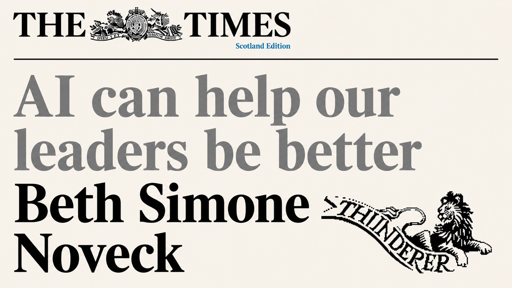
AI Can Help Our Leaders Be Better
In an article originally published in The Times (Scottish Edition), Beth Simone Noveck argues that AI’s most important democratic use is helping governments listen. Drawing on examples from Camden and Scotland, the piece explores how AI could help public institutions process large-scale public input, strengthen participation, and rebuild trust at a time when governments face rising demand and declining capacity.
Published on May 14, 2026 by Beth Simone Noveck
Governing AI
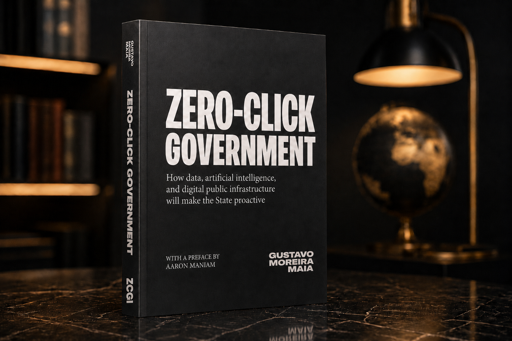
Zero-Click Government: Omakase or Loss of Agency?
In the afterword to Gustavo Maia’s forthcoming book Zero-Click Government, Beth Simone Noveck explores the democratic risks and possibilities of anticipatory governance. While supporting efforts to reduce the administrative burdens placed on citizens, she argues that traditional requests and applications also served as an important democratic feedback signal, one that anticipatory systems risk losing when governments act on inferred demand. Her response examines what kinds of participation, transparency, contestation, and institutional learning are needed if public action is increasingly shaped by data and AI.
Published on May 13, 2026 by Beth Simone Noveck
Governing AI
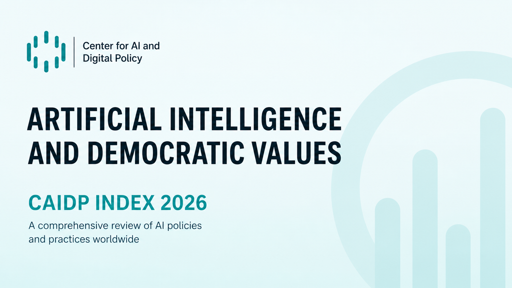
Progress on Global AI Governance: The CAIDP AI Index and Implications for the Public Sector
The 2026 CAIDP AI Index, ranking AI policy commitments across 90 countries, shows that while most governments now agree on core governance principles, the real divide lies in implementation. Many are advancing laws, oversight, and public participation, but progress lags in turning commitments into practice. As the baseline shifts from whether to govern AI to how, the report underscores that outcomes depend less on frameworks and more on the capacity of public institutions—and the civil servants within them—to operationalize these principles in everyday decisions.
Published on May 6, 2026 by April Yoder and Grace Thomson
Governing AI
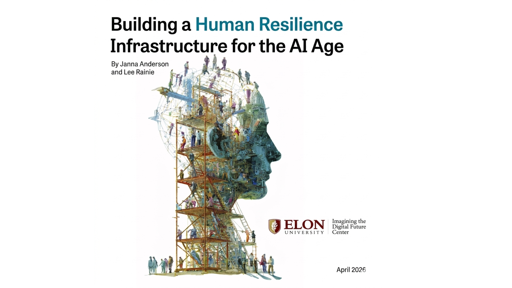
The New Human Resilience Challenges Posed by AI
In “Building a Human Resilience Infrastructure for the AI Age,” based on insights from 386 global experts, a warning emerges: the greatest risk is not a single catastrophic event, but a slow drift toward diminished human agency, fragmented reality, and growing dependence on automated systems. Lee Raine and Janna Anderson reflect on how, as AI becomes society’s invisible operating system, individual resilience is no longer enough. The report argues for urgent, coordinated action to build resilience as shared infrastructure across governments, institutions, and communities to ensure people can still question, contest, and shape the systems increasingly shaping them.
Published on Apr 13, 2026 by Lee Rainie and Janna Anderson
 InnovateUS